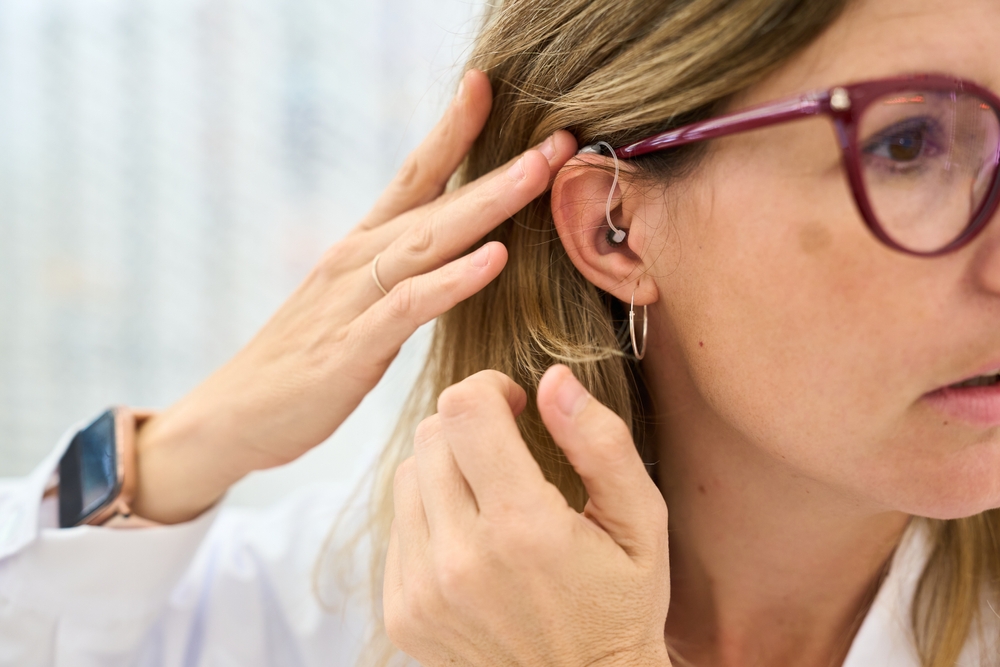
Many people delay getting hearing aids because they don’t think they’ll like how they look or feel. That defensive reaction is totally logical from a consumer standpoint! Regrettably, some people even experienced social alienation because acquaintances falsely assumed that wearing a visible aid signaled a complete inability to comprehend spoken dialogue.
For many people, this image has stuck, making them hesitant to take the next step. In reality, the sophisticated hearing instruments of the present era deliver a look and feel that shatters these old assumptions. Advances in design and technology have made them smaller, more comfortable, and far more discreet.
Should your reluctance stem entirely from memories of obsolete, bulky hardware, you owe it to yourself to discover current medical advancements.
The Hearing Aid You’re Picturing Doesn’t Really Exist Anymore
If you close your eyes and picture a hearing aid, you might imagine something large, hooked over the ear, and visible from across the room. If that description matches your mental model, your perceptions are anchored in the primitive analog technology of the late twentieth century.
In the intervening decades, the entire field of otolaryngology and acoustic engineering has undergone a massive paradigm shift. Advances in miniaturization, design, and digital technology have completely reshaped what hearing aids look like today. They’re smaller, sleeker, and designed to blend in (or disappear entirely).
Many of today’s devices sit fully inside the ear canal, making them virtually invisible during everyday conversation. Different configurations sit comfortably behind the ear but feature such a low profile and featherweight build that observers naturally miss them.
Understanding Your Options: A Guide to Contemporary Device Form Factors
To understand how these sophisticated medical devices are physically configured, review this concise anatomical breakdown:
The Invisible-in-Canal (IIC) Form Factor
This tier represents the absolute pinnacle of cosmetic concealment. An IIC device is positioned entirely past the second bend of the auditory canal, fabricated from a personalized physical matrix of your unique anatomy. Spoken interactions at arm’s length occur without anyone realizing a medical device is present. They’re a popular choice for people with mild to moderate hearing loss who prioritize subtlety.
The Versatile Receiver-in-Canal (RIC) / Receiver-in-the-Ear (RITE) Style
Statistically, this open-fit design represents the dominant choice among current consumers. A tiny component sits behind the ear, connected by a nearly invisible wire to a small speaker in the ear canal. To onlookers, this streamlined design closely mirrors fashionable consumer electronics or sports earbuds. Unless an individual is specifically searching for the device, it remains completely unnoticed during normal interactions.
Traditional Behind-the-Ear (BTE) Reimagined
This style positions the main component body post-auricularly, offering a slightly larger footprint that remains beautifully sculpted and sleek. Clinically indicated for profound or severe hearing deficits, they deliver immense acoustic power without the outdated, conspicuous mass of the past.
The bottom line is simple: modern assistive hearing systems are crafted to serve your life quietly, not to draw attention to your ears.
Modern Hearing Aids: Looking Better and Doing a Lot More
It is vital to recognize that this technological revolution is not simply a visual upgrade. Contemporary devices are essentially miniature smart hubs rather than historical medical hardware. A vast majority feature native Bluetooth connectivity, enabling seamless, wireless streaming of telephonic communication, media, and television audio directly into your auditory pathway.
Equipped with dedicated smartphone applications, they allow users to manipulate volume matrices or toggle environmental programs without making manual physical adjustments. Should you transition into a loud social environment, you can instantly recalibrate your directional microphones via your phone screen. Advanced rechargeable battery banks have effectively replaced the small, fragile power cells that used to cause immense frustration. You merely dock the devices on a nightstand inductive charger, exactly like replenishing your mobile phone.
Empowerment Over Hesitation: Redefining Hearing Health Care
Despite being aware of these massive design improvements, it is entirely normal to feel a sense of hesitation. Initiating an auditory health journey can feel emotionally taxing because it requires acknowledging that our physical baseline has shifted over time. This realization can occasionally induce feelings of helplessness, leaving patients feeling detached from their own physical autonomy.
Let’s reframe this narrative completely: acquiring a modern acoustic instrument is not an admission of weakness. They’re simply a sign of change, which happens to us all. They’re proof that you’re taking action to support and equip your body in essential ways.
Imagine wearing a discreet, barely (if at all) visible device and finally being able to follow along in conversation, hear better in crowds, and focus on the things that really interest you. This is the definition of true personal empowerment!
Discover the Reality of Modern Otolaryngological Solutions
The easiest way to let go of that outdated mental image is to check out for yourself what’s available. We encourage you to drop by our office, address your concerns, and hold these miniature devices yourself with zero sales pressure. Consider it a chance to see and feel how different modern hearing aids really are.
You will likely be utterly delighted to discover how microscopic, physically seamless, and high-performing today’s options truly are! Please contact our patient care coordinators or utilize our digital portal to secure your consultation this week.